
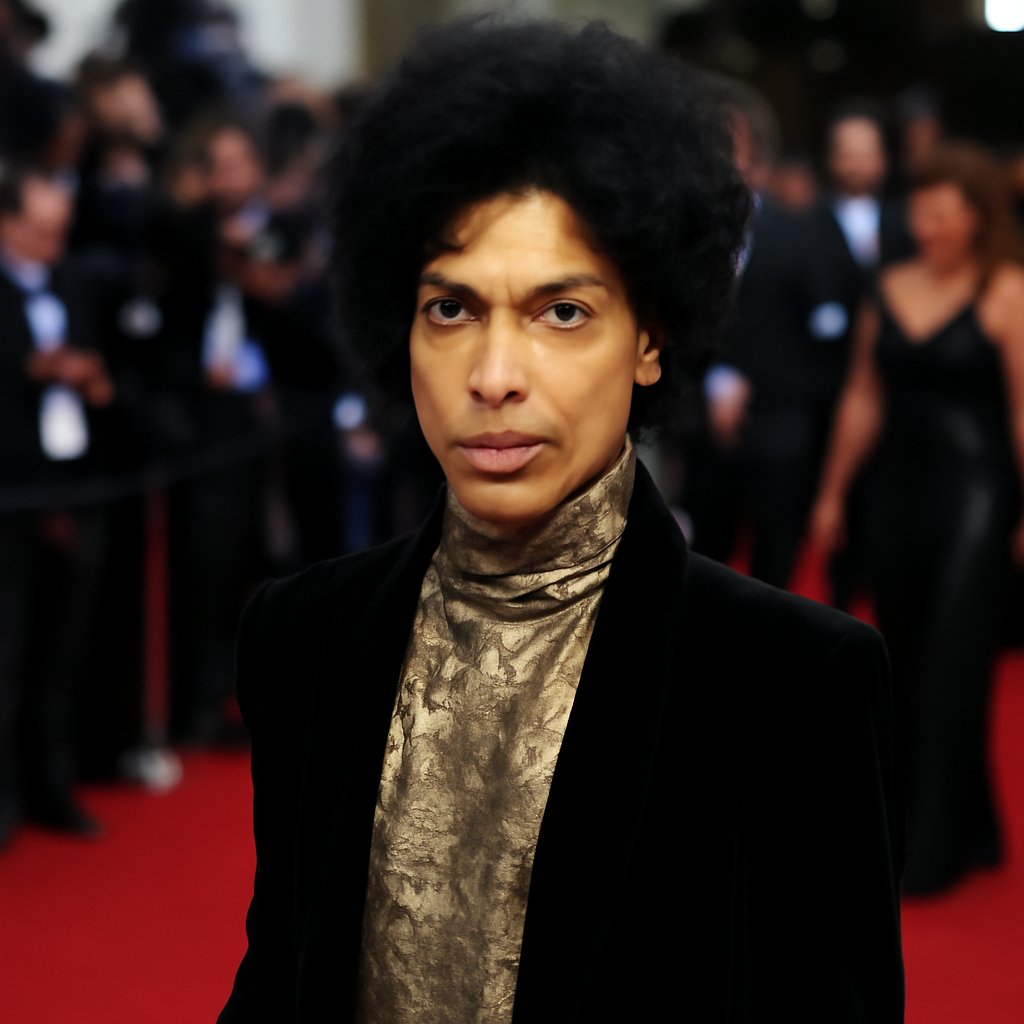
Covering Hollywood for over a decade, you learn quickly that Prince didn’t just make music—he engineered cultural earthquakes that still ripple through red carpets, studio lots, and the way Black excellence claims space in entertainment. His boundary-shattering approach fused raw talent with technical wizardry, reshaping everything from pop production to the way artists navigate power dynamics in an industry that often tries to box in Black innovators.
Prince’s command of nearly every instrument on his recordings set a standard few have matched. From the age of seven, he taught himself guitar, piano, drums, and bass, frequently tracking every part himself to lock in a singular vision. That self-reliant method fueled albums like 1980’s Dirty Mind, where gritty funk grooves collided with rock attitude in ways that felt both intimate and revolutionary.
His early experiments at Sound 80 studio in Minneapolis revealed a mind obsessed with sonic architecture. Bouncing tracks between machines let him craft dense layers without relying on a full band, a move that anticipated the DIY ethos many artists chase today. Later, the crisp snap of the Linn LM-1 drum machine on 1999 became a signature of 1980s pop, proving Prince could weaponize technology as skillfully as he wielded a Telecaster.
This is a story Black entertainment journalists have watched unfold for years: Prince’s fearless genre alchemy—blending funk, rock, R&B, new wave, and jazz—while deploying that soaring falsetto and fluid vocal style that upended gender expectations in mainstream music. Sign o’ the Times showed his range, swinging from skeletal arrangements to thick funk workouts with ease. Guitar lines on tracks like “Purple Rain” echoed Hendrix yet carved their own path through blues scales and psychedelic textures, all anchored by the biting tone of his Hohner Telecaster. Synthesizers like the Oberheim OB-Xa helped define the Minneapolis sound that influenced everyone from Michael Jackson to today’s chart-toppers.
Prince’s approach to production represented a radical departure from industry norms. While most major artists relied on established producers and session musicians, Prince’s insistence on hands-on control meant he could execute ideas faster and maintain artistic coherence across entire albums. His recording methodology became legendary—working in marathon studio sessions where he’d layer vocals, horns, and strings with meticulous attention to detail. The tightness and precision of albums like 1999 and Purple Rain stemmed directly from this singular focus, where every arrangement choice served the song rather than industry convention.
The technical specifications of his recordings reveal an artist thinking decades ahead. Prince embraced MIDI (Musical Instrument Digital Interface) technology early, allowing him to sequence complex arrangements that would have required orchestras to perform live. His use of the E-mu Emulator synthesizer on tracks like “Raspberry Beret” demonstrated how sampling could enhance rather than replace live instrumentation. This hybrid approach—blending organic and electronic—became a template for how modern producers approach pop music today, from The Weeknd to Anderson .Paak.
Prince’s innovations crossed straight into Hollywood with Purple Rain, the semi-autobiographical film whose soundtrack married narrative drive with live-wire performance energy. Onstage he transformed concerts into theatrical spectacles—lighting shifts, rapid costume changes, and crowd communion that turned shows into cultural events. The Symbol era’s experimental branding and distribution tactics foreshadowed the streaming battles artists fight now. His decision to release music exclusively through his own channels and later platforms gave him leverage that most artists only dream about, establishing a blueprint for artists seeking ownership and control.
Behind the scenes at Paisley Park, Prince worked with analog tape and early digital tools, often finishing full albums in weeks. His songwriting could be lightning-fast; “Kiss” reportedly came together in a single afternoon, stripped to essentials for maximum punch. The minimalism of that track—featuring just bass, drums, and vocals—contradicted everything the 1980s production landscape valued, yet it became one of his signature hits. This willingness to subtract rather than add, to challenge his own success, kept his output fresh across four decades.
Prince’s mastery of the recording studio extended to his understanding of space and dynamics. Rather than competing for volume through compression and limiting like many of his contemporaries, Prince created depth through arrangement. The way a snare crack would sit in a mix, or how a backing vocal would float beneath the lead, showed an engineer’s precision. His work with engineer Susan Rogers at Paisley Park produced some of the cleanest, most impactful pop recordings of the 1980s and ’90s—records that still sound vibrant and alive compared to more heavily processed contemporary work.
His approach to live performance innovation redefined what a rock/pop show could be. The New Power Generation and later iterations of his backing bands weren’t just supporting players—they were virtuosos trained to execute Prince’s elaborate arrangements while remaining fluid enough to follow his improvisational whims on stage. Watching Prince conduct a band through a three-hour set, gesturing musicians in and out of sections, fundamentally changed how artists thought about live performance energy and band dynamics.
The relationship between Prince’s studio innovations and his live performances created a feedback loop that strengthened both. Studio experimentation like the heavily processed vocals on “Controversy” or the stark production of “When Doves Cry” translated directly to stage through carefully designed sound systems and real-time processing. He invested heavily in live sound technology that allowed him to recreate studio magic in venues worldwide, something that wouldn’t become industry standard until decades later.
Prince’s influence on contemporary production extends to his approach toward melody and harmony. His basslines, often deceptively simple on first listen, carried harmonic movement that would make jazz musicians nod in recognition. Tracks like “Sign O’ the Times” featured bass work that suggested chords rather than stating them directly, leaving space for listener interpretation. This sophistication lurking beneath accessible melodies meant his music satisfied both casual radio listeners and musicians picking apart his work.
Key facts underscore the scale of his impact:
– Prince played over 27 instruments across his discography, often handling all tracking solo.
– He released 39 studio albums, many self-produced to industry-shifting standards.
– “When Doves Cry” held the top spot for five weeks and famously dropped the bass guitar entirely.
– The 1984 Purple Rain soundtrack moved more than 20 million copies worldwide.
– Seven Grammy wins, many tied to his production breakthroughs.
– Live, he switched seamlessly across more than 100 instruments during tours.
– The 1990s Love Symbol period delivered jazz-funk explorations like The Gold Experience.
– Over 500 artists, from Beyoncé to Questlove, have cited his direct influence.
– He brought the Fairlight CMI sampler into pop contexts years ahead of the curve.
– Shows routinely ran three hours with extended improvisational jams.
– His vault holds over 8,000 unreleased tracks.
– Around the World in a Day folded in psychedelic textures before they became trendy.
– His falsetto spanned more than three octaves in the studio.
– Prince’s publishing catalog includes compositions recorded by over 300 artists.
– He personally engineered most of his recordings, taking sole production credit on the vast majority of his work.
Prince’s techniques keep informing new generations, a legacy that honors Black creative sovereignty while challenging Hollywood’s old hierarchies. His recordings and performances still command attention because they were built to last. Modern producers studying arrangement, engineers examining mix techniques, and musicians learning how to balance genre boundaries all find themselves circling back to Prince’s foundational work. His insistence that technical mastery and artistic vision could coexist—rather than one compromising the other—remains the most revolutionary aspect of his legacy.